
Nervous system protective patterns: when helpful responses become stuck
Sep 17, 2026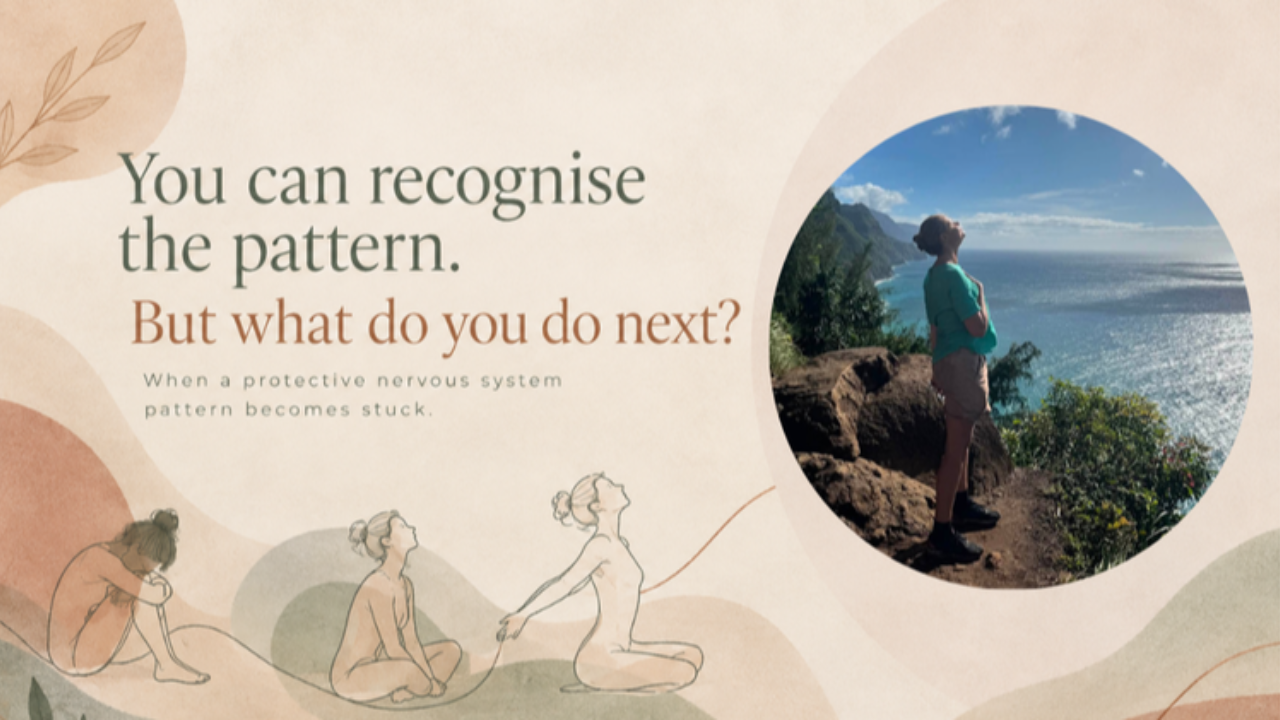
Most of us have nervous system patterns that have helped us at some point.
We may have learned to keep going, stay busy, please others, withdraw, hold everything together, or shut down and conserve energy when there is too much.
These patterns aren’t necessarily the problem.
The difficulty comes when a protective pattern becomes stuck or rigid, and we lose the flexibility to move between nervous system states in a way that supports what is happening in the moment and the occupation we need to participate in.
We might shut down and conserve energy, but then struggle to mobilise again.
Or we might move into a constant go, go, go state and find it difficult to switch off, rest and restore.
The work is not necessarily about getting rid of these patterns.
It is about helping the nervous system develop more flexibility and choice.
Protective patterns often have a purpose
When we recognise a nervous system response such as fight, flight, freeze, shutdown or appease, it can be tempting to focus on the state itself.
But I think there is another question we need to ask:
What is this pattern helping the person do, and where is it now getting in the way?
A pattern may have developed because it was useful.
Staying busy may have helped someone keep functioning during a difficult period.
People-pleasing may have helped maintain connection or reduce conflict.
Shutdown may have helped the nervous system conserve energy when things became too much.
These responses can make sense when we understand the context in which they developed.
The difficulty is when the response is no longer flexible.
The nervous system continues to use the same protective strategy even when the situation has changed.
When the pattern doesn’t switch off
Imagine someone whose system moves into shutdown when they become overwhelmed.
That response may help conserve energy and reduce input.
But what happens when the person then needs to get up, go to work, prepare food, connect with their family or participate in something that matters to them?
How do we support enough mobilisation for them to re-engage?
Or perhaps someone spends most of their day in a highly mobilised state.
They are productive, responsive and always doing something.
That pattern may have helped them achieve a lot.
But when the workday ends, their system may not know how to slow down.
Rest feels difficult.
Their mind keeps going.
Their body remains activated.
They may be exhausted and still unable to switch off.
In both situations, simply identifying the nervous system state is only the beginning.
The clinical question becomes:
What would support greater flexibility in this system?
Moving beyond fight, flight, freeze and fawn
Understanding nervous system states can give us useful language for what we are noticing.
But knowing that someone is in fight, flight, freeze, shutdown or appease doesn’t automatically tell us what to do next.
Within an embodied approach, we can become curious about the function of the pattern.
What has this response protected?
What has it enabled the person to do?
What resources are already available?
Where has the response become restrictive?
And what capacity might help the person move towards greater choice and participation?
This helps us move away from treating the nervous system response as something that needs to be fixed.
Instead, we can understand it as a response that has served a purpose, while also recognising when it may no longer be supporting the person in the way it once did.
Flexibility matters more than being “regulated” all the time
The aim is not to stay in one calm nervous system state throughout the day.
We need access to mobilisation.
We need energy to act, focus, move, communicate, protect ourselves and participate in life.
We also need the capacity to slow down.
To rest.
To recover.
To connect.
To conserve energy when appropriate.
A flexible nervous system can move between these states in response to what life is asking of us.
So the goal is not necessarily less activation or less shutdown.
The goal is greater awareness, flexibility and choice.
Can I mobilise when I need to?
Can I return to rest when the demand has passed?
Can I recognise when a protective pattern is taking over?
And do I have resources that help me find my way back?
A reflection you might explore
You might like to consider one protective pattern that shows up in your own life or work.
Ask yourself:
- What nervous system pattern has helped me in the past?
- What did it enable me to do well?
- Is that pattern still serving me now?
- Where might it have become a little stuck?
- What is the cost of staying in this pattern?
- What might I be missing out on because of it?
- What helps me move towards greater flexibility?
There is no need to judge the response.
The pattern developed for a reason.
We can acknowledge what it has done for us while also becoming curious about whether something different is now available.
Bringing this back to Occupational Therapy
For OTs, this work becomes especially important when we connect nervous system flexibility back to occupation.
We are not only asking:
What state is this person in?
We are also asking:
How is this affecting their ability to participate in everyday life?
Perhaps shutdown is making it difficult to begin the morning routine.
Perhaps chronic mobilisation is interfering with sleep.
Perhaps appeasing patterns are affecting boundaries at work.
Perhaps someone is so used to pushing through that they no longer notice fatigue until they reach complete depletion.
Our role is not simply to identify the pattern.
It is to help the person understand what may be happening without shame, recognise what the response has been protecting, build resources and capacities, and gradually develop more options for responding.
From the body, through emotions and thoughts, and back into daily life and occupation.
Finding a way back to flexibility
Sometimes the most useful question isn’t:
“How do I stop this nervous system response?”
It might be:
“Do I have a way back to myself, and back to greater flexibility?”
That might involve external resources.
Movement.
Breath.
Sensory input.
Connection.
Rest.
Boundaries.
Environmental changes.
Co-regulation.
Or simply becoming more aware of the early signs that a familiar protective pattern is beginning to take over.
The specific resource matters less than the clinical reasoning behind it.
What does this person need?
What is their nervous system communicating?
What capacity are we trying to build?
And how will that support the occupations and relationships that matter to them?
This is part of what we explore inside Embodied OT Foundations.
Not simply recognising nervous system states, but developing the clinical reasoning to understand what might support this person, in this moment, towards greater flexibility and participation.
If you would like to explore how somatic, nervous-system-informed approaches can sit within your Occupational Therapy practice, you’re welcome to book a Connection Call with me.
Book a Connection Call:
https://sarita-sloane-ot-yoga.splose.com/online-booking/5788c544-0b22-4059-93c9-e8931ed98847
Want more of this?
Do you need more of this for your wellbeing journey, or do you want to learn more?
If this feels like something that would benefit you and you would like to work with Sarita in therapy sessions, Please send in a "Make a referral" Form.
If you would love to integrate more tools and strategies like fascia release and nervous system regulation into your therapy practice with your clients, Please reach out and contact me or check out the Embodied OT Program.
Contact Sarita
If you would like to make an enquiry and contact Sarita, please use the form below or email [email protected]
We hate SPAM. We will never sell your information, for any reason.
