
Interoception in Occupational Therapy: Where Do We Start?
embodied ot interoception nervous system regulation occupational therapy somatic practice Sep 14, 2026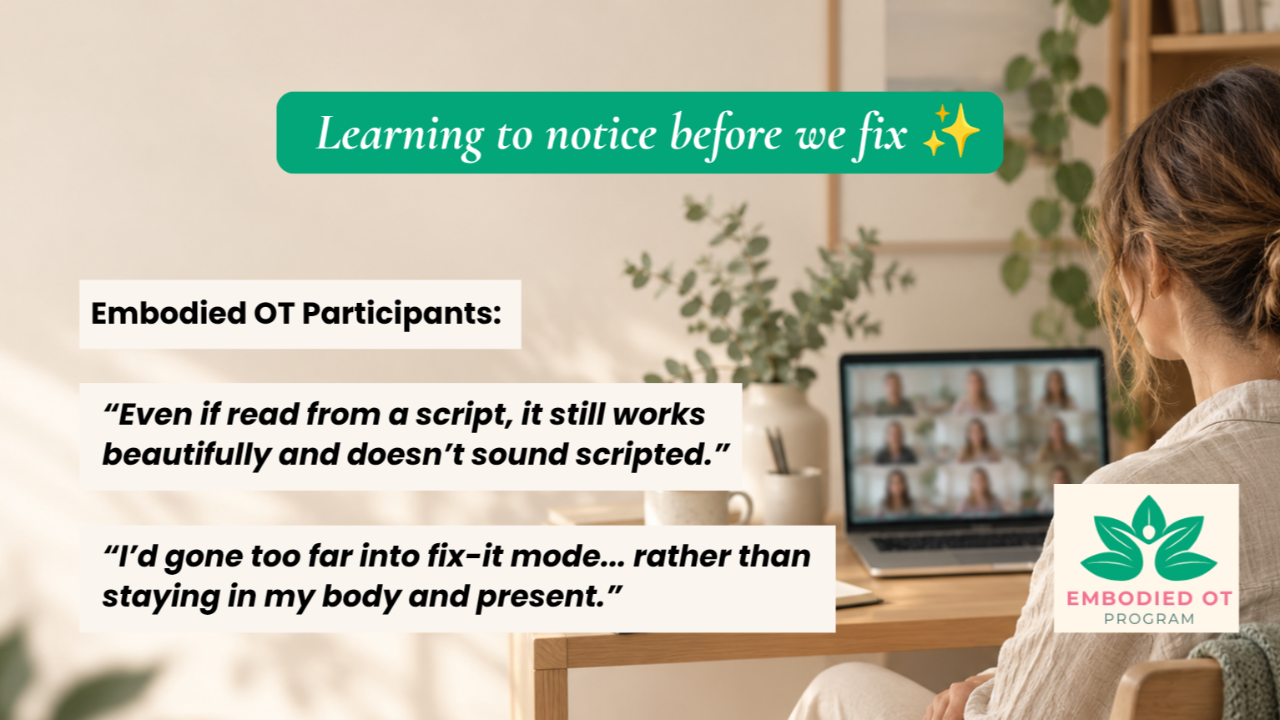
We know interoception is important.
It can support self-awareness, regulation, decision-making, and participation in everyday life.
But knowing that interoception matters and knowing how to work with it safely in practice are two different things.
What happens when a client lives with persistent pain?
Has a trauma history?
Feels disconnected from their body?
Becomes overwhelmed by internal sensations?
Or simply has difficulty recognising what they are noticing and what those sensations might mean?
For some people, simply asking:
“What do you notice inside your body?”
may not be the best place to begin.
So where do we start?
Interoception is more than noticing body sensations
Interoception is often described as our awareness of internal body signals.
Hunger.
Thirst.
Temperature.
Breathing.
Heart rate.
Fatigue.
Tension.
Activation.
But in Occupational Therapy, I think we need to take the conversation further.
The question isn’t only:
Can this person notice what is happening inside their body?
We also need to ask:
What capacity are we actually trying to develop, and how might this support the person’s occupational goals?
For one person, developing interoceptive awareness might help them recognise overwhelm early enough to take a break.
For another, it might mean noticing hunger, thirst or fatigue before reaching depletion.
It might be recognising anxiety signals and responding before they escalate.
Or becoming more aware of what the body is communicating about boundaries, sensory load, rest or support.
This is where interoception becomes more than a body-awareness exercise.
It becomes connected to participation in everyday life.
We don’t always begin by going inside
One of the principles we explore within Embodied OT is the importance of considering where the person is starting from.
For some clients, internal sensations may feel unfamiliar, confusing or even unsafe.
So rather than immediately directing attention inward, we may begin with the environment.
What can they see?
What can they hear?
Where do they notice support underneath their body?
Is there something in the room that feels pleasant, familiar or steady?
From there, we can notice what happens in the nervous system and gradually explore whether moving towards internal awareness feels accessible.
This isn’t about following one fixed sequence for every client.
It is about clinical reasoning.
We offer a regulation resource or tool, notice what actually happens in the body, ask for feedback along the way, and adapt from there.
The occupational question matters
As OTs, our work doesn’t finish when someone becomes more aware of a sensation.
We want to understand what that awareness makes possible.
Perhaps recognising fatigue earlier helps someone pace their working day.
Perhaps noticing activation supports someone to step away before an interaction becomes overwhelming.
Perhaps recognising hunger and thirst supports more consistent self-care routines.
Perhaps understanding sensory overload helps someone advocate for changes within their environment.
This connection back to daily life can also help create client buy-in.
When someone understands why we are inviting them to notice their body, and how this connects to something that matters in their life, the practice has a clear purpose.
Within Embodied OT, regulation isn’t the endpoint.
We are interested in what greater regulation, awareness and flexibility can make possible in the person’s occupations, relationships, routines and participation.
Interoception also asks something of us as practitioners
There is another layer to this work that I think is easy to overlook.
Our own nervous system is in the room too.
In our recent Embodied OT live learning, we discussed how easily practitioners can move into “fix-it mode”.
A client is struggling.
We want to help.
So we move quickly into thinking, problem-solving and trying to find the right intervention.
And sometimes, while trying to solve the problem, we lose connection with our own body and presence.
Embodied practice invites us to notice this too.
Can I remain connected with myself while I am listening?
Can I notice when I am rushing?
Can I stay curious rather than immediately trying to solve?
Can I regulate and resource myself enough to remain present with another person’s experience?
Part of supporting regulation isn’t simply knowing which practice to offer.
It is also developing our own capacity for presence, attunement, pacing, co-regulation and therapeutic use of self.
From knowing a practice to knowing when to use it
This is why experiential learning is such an important part of Embodied OT Foundations.
It is one thing to read about an interoceptive practice.
It is another to experience it in your own body.
Then practise guiding another person.
Notice how they respond.
Ask for feedback.
Adapt your language, pacing or approach.
And begin understanding why you might use that practice with one client, modify it for another, or decide not to use it at all.
This is where clinical confidence starts to grow.
Not through memorising more scripts, but through developing a framework for asking:
What am I noticing?
What might this person’s body and nervous system be communicating?
What capacity are we trying to develop?
What is the occupational purpose?
What could I offer, and do I have consent?
What happens when we try it?
Do we continue, reduce, change direction or stop?
How do we connect what changed back into everyday life?
This is where somatic and interoceptive practices begin to sit within Occupational Therapy rather than being used as isolated techniques.
There isn’t only one way to begin
Interoception can be an important part of nervous system regulation, self-awareness and occupational participation.
But asking someone to “notice what you feel in your body” isn’t always enough.
Sometimes we begin outside the body.
Sometimes we resource first.
Sometimes we work with movement, the environment, breath, sensory input or connection.
Sometimes we stay exactly where we are and allow more time.
The question isn’t simply:
How do I teach interoception?
Perhaps a more useful question is:
What does this person need in order to develop greater awareness, regulation, and choice, and how could that support the life they want to participate in?
That is where interoception begins to sit within the broader Embodied OT framework.
And where the work becomes distinctly Occupational Therapy.
Want to explore this further?
Inside Embodied OT Foundations, we explore interoception alongside nervous system regulation, somatic practice, trauma-informed care, practitioner presence and occupation-centred clinical reasoning.
You learn the frameworks behind the work, experience the practices yourself, practise facilitating them with others, and explore how to adapt them across different clients and clinical presentations.
If you’re curious about whether the Embodied OT Program could support you in your own practice, you’re welcome to book a Connection Call with me.
Book a Connection Call:
https://sarita-sloane-ot-yoga.splose.com/online-booking/5788c544-0b22-4059-93c9-e8931ed98847
Warmly,
Sarita
Want more of this?
Do you need more of this for your wellbeing journey, or do you want to learn more?
If this feels like something that would benefit you and you would like to work with Sarita in therapy sessions, Please send in a "Make a referral" Form.
If you would love to integrate more tools and strategies like fascia release and nervous system regulation into your therapy practice with your clients, Please reach out and contact me or check out the Embodied OT Program.
Contact Sarita
If you would like to make an enquiry and contact Sarita, please use the form below or email [email protected]
We hate SPAM. We will never sell your information, for any reason.
Categories
All Categories body wisdom burnout recovery dance embodied healing embodied ot embodiment fascia release flow freedom grief and loss healing the heart inner peace interoception interoceptive awareness movement medicine nature nervous system regulation nervous system reset occupational therapy pleasure presence radiance sutras self acceptance self compassion self-love sensuality somatic somatic awareness somatic inquiry somatic practice yoga yoga for fascia